
At the age of 27, Charlène became pregnant unintentionally. Her partner at the time panicked and pressured her to have an abortion. She wanted to keep the child, but she found no support at the Planned Parenthood counselling centre she turned to: they just wanted to abort her child. When she hesitated, she was told that she should ‘not talk about a baby,’ that it was just ‘a cluster of cells.’ Charlène resisted the pressure for a long time, refusing to take the preparatory medication. In the end, she gave in. Her boyfriend forced the abortion pill into her mouth Just weeks later, she broke up with her partner, fell into a deep depression and struggled to get her life back on track. Today, Charlène has a family again. But she cannot forget what she went through. ‘You can only learn to live with it,’ says the young woman. Her appeal to European politicians: ‘Protect women’s rights against pressure and coercion! Create real alternatives!’
Charlène was one of five women telling their stories in the European Parliament yesterday. Each story was different, but what they all had in common is that the women were left alone at one of the most crucial moments of their lives.
Nirvana is one of them, a young Dutch woman who cries repeatedly during her presentation. A single mother of three children from different fathers, she bitterly regrets her only abortion and works day and night to give her children a better future. She talks about her fear of not making it, her anger at the injustice of having to bear the burden of caring for her children alone far too often. And her gratitude to the aid organisation for pregnant women in need that gave her the courage and financial means to have her third child, despite everything.
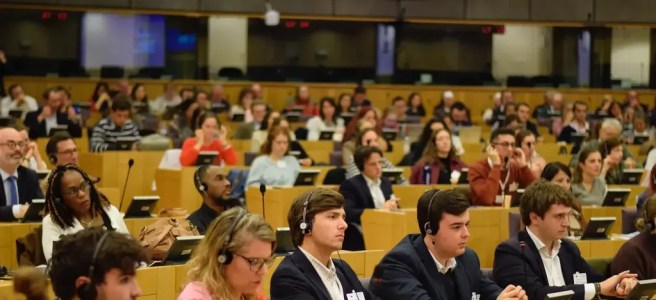
‘Real choice means real support’ was the title of the event : this does not mean tat the organisers the European pro-life federation ONE OF US and the European Center for Law and Justice, have suddenly become pro-choice, but that they expose the hypocrisy of those framing abortion as a choice. The goal: to make helping pregnant women in need across Europe a priority. The conference room was filled to capacity with almost 300 people from over 20 countries. Young faces filled the rows. The meeting on the Pariament’s premises was hosted by MEPs Peter Agius (Malta) from the European People’s Party (EPP) and 31-year-old Paolo Inselvini (Italy) and Laurence Trochu (France) from the European Conservatives and Reformists Group.
As readers of this blog know, ONE OF US started as a European Citizens’ Initiative, which in 2014, with the support of almost two million signatures from European citizens, called on the European Commission to stop funding abortion and embryo research. Although no other European Citizens’ Initiative before or since has been able to gather anywhere near as many votes, the European Commission refused to appropriately follow up on ONE OF US request at the time. Since then, the initiative has become an umbrella organisation of pro-life organisations from all over Europe, calling for the protection of the right to life and human dignity from conception onwards at European level – a political ‘hot topic’.
The purpose of holding the conference was to respond to a pro-abortion citizens’ initiative, “My Voice, My Choice”, which gathered around 1.2 million signatures, far less than ONE OF US, but still enough support to call on the European Commission to introduce new legislation. The European Commission, beholden to what critics appropriately describe as the “Culture of Death” (i.e., abortion, contraception, sodomy, transgender, and the compensation of the resulting lack of children by mass migration from predominantly Islamic countries), seems keen to do everything it can to accomodate the pro-abortion initiative’s demands, even though those demands not only show no respect for mothers and children, but also violate the European treaties. My Voice My Choice wants the EU to finance and organise – at the expense of taxpayers – an “abortion tourism” from countries with restrictive abortion laws to countries with permissive laws, in clear violation of the principle of subsidiarity and of the EU’s obligation to loyally support Member Sates who make their own policy choices in a field pertaining to their exclusive policy. Once again, it becomes apparent that the abortion lobby, which euphemistically describes itself as “pro-choice”, is in fact not in favour of any choice that does not result in killing unborn children.
ONE OF US President Tonio Borg denounced this attempt to misuse European funds for ‘abortion tourism’ in no uncertain words in his opening speech. Borg, a former EU Health Commissioner from Malta, is better placed than most to know and explain what the EU’s health budget may, or must not, be used for: ‘This initiative (My Voice, My Choice) violates the principle of subsidiarity, because according to the European treaties, each Member State can decide for itself how to deal with issues such as maternity, euthanasia and abortion.’
In the opinion of the assembled speakers – in addition to those already mentioned, other MEPs such as Miriam Lexmann (EPP) from Slovakia, Isabel Benjumea (EPP) from Spain and Antonella Sberna (ECR) – it would be grossly illegal for the European Commission to approve such funding, which would in fact be a hostile act against Member States such as Malta or Poland, using a budget to which these countries are contributing to help people in circumventing their own national legislation.
Financed by wealthy donors, the pro-abortion ECI had nearly five times the budget that ONE OF US had, but still collected far less signatures: a clear indication that their priorities are not those of ordinary citizens, but of powerful elites who want to force abortion on society. Fittingly, the group is not passively waiting for the European Commission to respond, but is also promoting its cause through the European Parliament: last Monday, the organisation’s ‘front woman’, Slovenian Nika Kovač, was a guest at the Committee on Women’s Rights and Gender Equality (FEMM), the European Parliament’s playground for ultra-radicals. A resolution to support My Voice My Choice is to be put to the vote at the European Parliament’s plenary session in November. ONE OF US, for its part, is apparently not making great efforts to mobilize against that resolution, given that it will in any case have no legal effect, and because they have better things to spend their scarce resources on.
Soemia Sibilio, director of a help centre for pregnant women in Milan, one of 400 centres that are part of the Italian ‘Movimento per la Vita’, explained what this can look like in practice. ‘Every day we open our doors without knowing who will come in. Every day we welcome women with different stories, whom we listen to without judgement, so that none of them feels alone in this situation.’ In addition to financial support, the help centres offer legal assistance, psychological care and support in leading an independent life with a child. ‘Thanks to this help, over 285,000 children have been born in the last 40 years,’ Sibilio said to thunderous applause from the audience.
This life-saving work of volunteers would certainly deserve to be funded by the European Commission, which currently does nothing to support pregnant women facing difficult choices, but instead is funding 80% of Planned Parenthood’s lobbying efforts through a so-called “operative grant” under the CERV programme, for which there appears to be no accountability whatsoever.
Leire from Spain also testifies that feminism that is truly interested in the welfare of women does not fight for more abortions, but for no woman to have to be afraid of giving birth to her child. A former abortion advocate, she herself has had an abortion and a miscarriage and suffered for years from the trauma of loss. Today, she accompanies other women with similar stories and says, ‘Behind every abortion is a woman who is suffering and has often experienced violence or pressure. Abortion is far too often the result of lack of freedom, not freedom.’
In light of the women’s testimonies, one participant of the event comes to the following conclusion: “Pregnant women in Europe are far too often left alone with their needs and fears. In the end, they decide to have an abortion out of desperation or because they are pressured by their partner or medical professionals. Instead, these women long for sympathy, encouragement and practical support. Effective help is therefore possible. The EU would therefore do well to make a decisive commitment to helping pregnant women in challenging life situations, so that they finally have the freedom to say yes to their own child.”
 one-of-us.org