
In today’s legal and political practice, there is a bad habit of redefining reality as one sees fit. There is hardly a law, and certainly no EU directive, that does not contain an extensive catalogue of legal definitions. This is considered good legislative practice that serves the purpose of legal clarity – but quite often it gives terms a meaning that they do not have in normal language use, or that even contradicts it blatantly. And especially in the case of abortion, which by its nature is an extremely gruesome practice, there are repeated attempts not only to embellish and ‘normalise’ it through euphemistic or misleading language, but also to slip it into factual and regulatory contexts in which it is completely out of place. In the English language, the term ‘termination of pregnancy’ is already trivialising because it suggests that it is the termination of a lengthy process at the end of which a human being might be created, thus obscuring the fact that the child in the womb is already a human being, which is why the so-called ‘termination’ is actually an act of killing. Even more cynical, however, is the attempt to present abortion as a ‘service’ that serves the “health” of women. At the international level, this attempt is pursued primarily through the consistent use of terms such as ‘sexual health,’ ‘reproductive rights,’ ‘sexual and reproductive health and rights’ (SRHR), etc., which were introduced into the language of the UN bureaucracy just over thirty years ago and from there found their way into the administrative language of many national authorities, the Council of Europe and the EU institutions, where they are now used as a matter of course. Of course, this is not the result of a development that could have emerged from the gradually changing language habits of the general public, but rather a use of language carefully planned and curated by politicians and bureaucrats, which serves above all to conceal: for example, it is apparently hoped that someone who agrees to a text that refers to ‘reproductive rights’ should only find out afterwards, post factum, that their agreement is now interpreted as consent to the killing of children before they are born.
Ambiguity has always been an important part of the strategy. If neologisms such as ‘reproductive rights’ or ‘sexual health’ were actually interpreted according to their literal meaning, no one could have anything against them: who would doubt that no one should be prohibited from reproducing, or that health, insofar as there can be an enforceable right to it, naturally also includes the health of the sexual organs? However, the inventors and users of these terms do not want to be pinned down to their actual literal meaning, but also want them to encompass novel, morally questionable ‘rights’ that they are reluctant to name.
In his address to the representatives of the Diplomatic Corps on 9 January this year, Pope Leo XIV warned against the distortion of language, which is perhaps partly unintentional but also, as it might seem, at least in part deliberate: “In our day, the meaning of words is becoming increasingly fluid and the concepts they represent increasingly ambiguous. Language is no longer the preferred means for people to get to know and encounter each other, but is increasingly becoming a weapon in the twists and turns of semantic ambiguity…. We must ensure that words once again express unambiguous, clear and distinct realities. Only in this way can authentic dialogue without misunderstandings be resumed.”
In issuing this warning, the Holy Father probably had in mind the events surrounding the EU abortion initiative ‘My Voice, My Choice’, to which he also alluded explicitly, without naming it, in the same address, just a few paragraphs later: ‘In this sense, the Holy See expresses deep concern about projects to finance cross-border mobility for the purpose of accessing the so-called “right to safe abortion” and considers it deplorable that public funds are used to destroy life instead of being invested in supporting mothers and families.’
The abortion initiative calls for the creation of an EU-funded mechanism to enable ‘women who do not have access to abortion in their own country’ to have their child aborted in another EU Member State. The organisers have not bothered to clarify exactly how such a mechanism would have to be designed in order not to violate EU law, leaving this difficult task to the European Commission. Prima facie, however, the creation of such a fund to promote abortion tourism clearly falls outside the Commission’s remit (which is limited by the principle of conferral). Against this background, it is astonishing – and unfortunately also suggests a certain ideologically motivated bias on the part of the decision-makers in favour of the intention pursued – that the initiative was approved at all and that the application for its registration was not rejected on the grounds that the EU was not the right addressee for such a petition.
In this context, the Commission’s response to a written question[1] submitted to it by two Members of the European Parliament is interesting: the Commission must register a citizens’ initiative if it is not manifestly (italics in the original) outside the Commission’s powers to propose a legal act of the Union for the purpose of implementing the Treaties. The Commission, wrote its Vice-President Maroš Šefčovič, had registered the initiative in question “because financial support for Member States’ measures to promote health could fall within the Union’s supporting competence (Article 168(5) of the Treaty on the Functioning of the European Union, TFEU). However, such support must comply with Article 168(7) TFEU, according to which the Union must respect the responsibilities of Member States for defining their health policy and for the organisation and delivery of health services and medical care, including sexual and reproductive health care.”
According to this statement, it could well be the case that the petition falls outside the competence of the EU; however, according to Šefčovič, this is not manifestly the case. This seems to have been sufficient for the Commission, which has deliberately set the bar quite low. This could give the impression of a certain bias, but it should be noted that the Commission, having applied stricter standards in the past, has already been condemned twice by the Court of Justice for not admitting a citizens’ initiative, which is why the approach of registering a citizens’ initiative in case of doubt seems understandable. On the other hand, it hardly seems appropriate to allow citizens to collect signatures for a year and then inform them afterwards that they could have spared themselves the trouble because their initiative did not meet the admissibility criteria. Perhaps the hope was that the initiative would garner such an overwhelming number of signatures and generate such strong political momentum that all objections and doubts could subsequently be dismissed as nitpicking. If such ulterior motives did indeed exist, then it must be said that this strategy has failed: ‘My Voice, My Choice’ may have exceeded the threshold of one million signatures, but it fell well short of the number of declarations of support collected by the ONE OF US pro-life initiative in 2014 for a diametrically opposed cause, namely a ban on the use of EU funds to finance any activity that involves or presupposes the destruction of human embryos.
The admissibility of the abortion initiative therefore still needs to be clarified, and the key issue here is whether abortion can actually be classified as a matter of ‘health policy’, as the proponents of the initiative claim and as the European Commission also seems to tacitly assume in its communication without providing conclusive justification.
Framing abortion as a ‘health service’ is probably even more important as a strategic goal for the abortion industry than any funding the European Commission could provide to promote abortion tourism. However, this is not a legal question, but a question of what the word ‘health’ means.
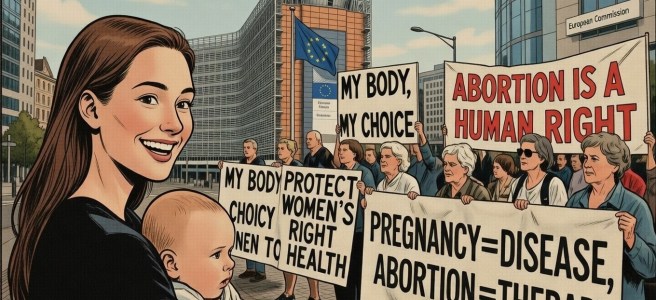
Aborting a child means to kill it, with killing being the purpose. It is the deliberate killing of a child in the womb – with the aim of getting rid of it simply because it is unplanned and unwanted. Abortion is not, by its very nature, a ‘health service’ and can never become one, no matter how artfully the words are twisted, because pregnancy is not an illness and killing a child is not a therapy.
Of course, there are also cases in which an immediate and very concrete threat to the life of the pregnant woman can only be averted by medical intervention, which then – as a consciously accepted collateral damage – also results in the loss of the foetus. Whether these cases can even be referred to as ‘abortion’ is doubtful, because the destruction of the foetus is not the guiding objective of the action, but merely an unintended side effect that must be accepted. The actual object of the action is then to save the life of the pregnant woman, and this is also completely legitimate, because a pregnant woman cannot be obliged to sacrifice her own life for the sake of her child’s life. Such life-saving interventions can undoubtedly also be classified as ‘health services’. However, the permissibility of such interventions is completely undisputed, and there are very clear regulations on this in all EU Member States – even in countries with comparatively restrictive abortion laws such as Poland or Malta – so that no woman in this emergency situation is forced to travel to a neighbouring country for an abortion.
These situations, in which one can actually speak of a ‘health service’, are therefore not the focus of the abortion initiative ‘My Voice, My Choice’: if it is not necessary to go abroad, then there is also no need for EU-subsidised abortion tourism. (The only exception would be cases where there is no actual danger to the pregnant woman’s life, but where such a danger is merely claimed in order to justify an abortion sought for other reasons. In such cases, one could very well speak of an abortion, but probably not of a ‘health service’, because it is not a matter of preserving the health of the pregnant woman, but of terminating the pregnancy.)
One could now go one step further, in line with the initiators of the abortion initiative, and argue that in cases where abortion is not punishable – and therefore ‘legal’ according to their use of language -, precautions must be taken to ensure that, in addition to the foetus (which is intended to be killed), the pregnant woman does not also suffer harm, which is why abortion should also be considered a ‘health service’ in these cases.
This argument, which for the abortion lobby is, as it were, the ‘lever’ with which it seeks to enforce all its socio-political ideas, is even justified to a certain extent – but only within very narrow limits. It overstretches the concept of ‘legal’ abortion and fails to recognise that the absence of punishment does not mean that it is a ‘right’ that should be guaranteed by the state. In such cases, abortion is not a ‘right’ but a tolerated evil, and it is not really a ‘health service’ but merely serves to realise a morally questionable ‘lifestyle’. Of course, even in such cases, the state must ensure that abortions are performed lege artis in compliance with the necessary hygiene regulations (and not as in the case of the notorious abortion doctor Dr Kermit Gosnell in Philadelphia) – but this can be achieved through a certain degree of professional supervision of these doctors and a legal system that holds them liable for malpractice.
It certainly does not follow that the European Commission may classify medically non-indicated abortion as a ‘health service’ and finance it under Article 168 TFEU. Medically non-indicated abortions are not health services, but the symptom of an irresponsible and morally questionable lifestyle.
It is no coincidence that abortions are regulated by criminal law in all EU Member States without exception – even in France, which in 2024 enshrined a so-called ‘right to abortion’ in its constitution to loud applause from the media, illegal abortions can be punished with imprisonment. This is a point of convergence between all legal systems, which differ only in terms of how generous the exceptions to criminal liability are.
Abortion therefore falls primarily within the remit of criminal law rather than healthcare. The reason for the ban on abortion is that in all legal systems in Europe, human life, including the life of children before birth, is considered a high-ranking, if not the highest-ranking, legal interest. It is undisputed that the Member States of the EU have the right (and also the duty) to protect such a high-ranking legal interest with appropriate means, which undoubtedly may include criminal sanctions.
The EU-funded abortion tourism proposed by ‘My Voice, My Choice’ would thus constitute an interference by the EU in the criminal justice systems of the Member States.
This would be inadmissible not only because the EU has only very limited regulatory and executive powers in the field of criminal law, which in any case do not concern the issue of criminal law on abortion, but even more so because this interference would be carried out with ‘hostile’ intent: the intention would clearly be to counteract the criminal law policy of the Member States and thwart the achievement of their objectives (in this case, the protection of unborn life) by enabling people to commit the act abroad who would otherwise not commit it.
This is clearly completely incompatible with the loyalty that the EU is not only owed by its Member States, but also itself owes to the Member States, which raises the question of how the Commission could ever have registered a citizens’ initiative with this objective. A Member State that does not wish to tolerate this could, incidentally, very easily defend itself and would not even have to take the Commission to the European Court of Justice. It would suffice to punish illegal abortions even if they are committed abroad. Extraterritorial criminal liability may be the exception rather than the rule in criminal law, but in principle a state is free to criminalise and prosecute crimes committed abroad. This is already the case today, for example, with child prostitution, and there is no objective reason why this could not also be done for abortion, surrogacy, human trafficking and similar offences if the regulatory purpose cannot be achieved in any other way.
To summarize, “abortion on demand” is not healthcare. Therefore, Article 168 TFEU cannot be invoked as a legal basis for the EU to fund abortions, not even in the form of a “supporting action” under Article 168 (5).
The policy area to which the regulation of abortion pertains is criminal justice. The EU has no competence to legislate on abortion, and it is bound by a duty of loyalty to not undermine the policy choices that Member States have made.
[1] Question for written answer E-000443/2025/rev.1 to the Commission, Bert-Jan Ruissen (ECR), Margarita de la Pisa Carrión (PfE)
 one-of-us.org