
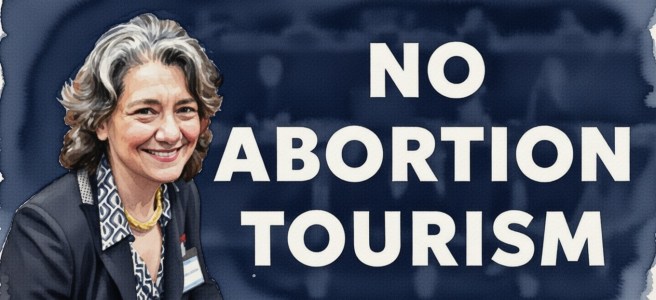
Interview of the Italian newspaper Il timone with the president of Movimento per la Vita (and former president of ONE OF US)
The wind blowing through European institutions brings nothing but death. From the constitutional right to abortion introduced in France to end-of-life laws, today, 26 February, the European Commission is called upon to respond to the popular proposal “My Voice my Choice”, which calls for the establishment of a mechanism to make abortion “safe and accessible” within member countries. In practice, if approved by the Commission, the mechanism would allow an Italian woman who has passed the first trimester of pregnancy – the limit set by Italian law for access to abortion – to receive financial support to have an abortion in another European country with less stringent limits. Or a Polish woman to receive telemedicine assistance from the Netherlands to obtain abortion drugs. All with public money.
‘Faced with this initiative, we must think of Pope Leo’s words on 9 January,’ said Marina Casini, president of the Italian Pro-Life Movement, whom we reached by telephone today to ask her a few questions on the subject. ‘The Pope expressed deep concern about projects aimed at financing cross-border mobility for access to the so-called “right to safe abortion”, considering it deplorable that public resources are allocated to the suppression of life, rather than being invested in supporting mothers and families.’
President Casini, today the European Commission is called upon to decide on the popular initiative ‘My Voice my Choice,’ which would effectively open the door to what has been called ‘abortion tourism.’ Can you explain what would happen in practice if it were confirmed and how European citizens’ money would be used?
“First of all, we hope beyond all hope that the initiative will not be accepted by the Commission. Unfortunately, it was already approved on 17 December by a large majority (358 in favour, 202 against, 79 abstentions) by the European Parliament, after the public hearing on 2 December, with a resolution concerning so-called “sexual and reproductive rights”, an expression that in reality conveys the claim to the “right to abortion”. Now, by its very nature, a resolution is not legally binding, i.e. it does not oblige the implementation of its content, but it does have significant cultural and political weight. Therefore, in theory, the Commission could disregard the resolution and reject the initiative “My Voice, My Choice: For Safe and Accessible Abortion”, but this will be very difficult, even if it is what we hope for.
If the initiative is confirmed, in practice the European Union (EU) will be committed to funding the travel expenses of women who want to have an abortion by moving from their country to a country where abortion laws are more permissive. It is abominable that EU money, which should be used to build cooperation aimed at achieving peace and justice at all levels, is being invested to financially support the war against the smallest, most defenceless, innocent and poorest human beings, namely unborn children. Not only that, but this is also a war against women, because instead of being freed from the conditioning that would push them to have an abortion, they are even more conditioned by an economic incentive to prevent the birth of the child they are carrying. This is also a terrible defeat for the true freedom of women, who should at least be offered an alternative to abortion and not a one-way street. Let us remember that the Universal Declaration of Human Rights states that the foundation of freedom is the recognition of the inherent and equal dignity of every human being; therefore, this includes the child who lives and grows under the mother’s heart.
We talk about freedom…
‘Calling abortion freedom is a deception because it is not freedom, but oppression. Defining abortion as a right is precisely the destruction of rights and human rights. Add to this the dramatic distortion of the principle of equality: it is not linked to the inherent and equal dignity of every human being – including those who are not yet born – but refers to the equal behaviour that one wishes to adopt: in this case, abortion. The supporters of “My Voice, my Choice” believe that the aim of the initiative is to reduce inequalities in access to safe abortion between Member States. Absurd. It would be like saying, for example, that in order to reduce inequalities in access to the death penalty in countries where it is subject to different regulations, the UN should make funds available so that those sentenced to death can be transferred to places where capital punishment is guaranteed to the fullest extent (instead, coincidentally, the UN General Assembly has repeatedly issued resolutions since 2007 calling for a general moratorium on capital punishment in the name of human dignity and the consequent right to life). The arrogant arrogance of the initiative called “My Voice, my Choice” is therefore obvious. But it is clear that we are faced with an ideology that today seems unassailable, but with time will show its monstrous face and collapse on itself, as happened with the Berlin Wall.
The Pro-Life Movement, together with other associations, has launched a petition called “Noabortiontourism” to counter the initiative. How did it go?
‘Yes, the Pro-Life Movement has been working hard to do its part. The ’Noabortiontourism” petition was courageously launched by the European Federation for Life and Human Dignity One of Us, of which the Pro-Life Movement has been a member since its inception.
The Federation comprises 50 associations from 18 European countries. In just a few weeks, with a simple “word of mouth” campaign echoing throughout Europe, the petition reached over 41,000 signatures. This is a remarkable result, which shows us how deeply the value of every human life from conception onwards is held in the hearts of many European citizens. The petition also leveraged an important point that should not be overlooked: the EU’s incompetence to decide on matters – such as abortion – that are the responsibility of individual countries, i.e. entrusted to the discretion of individual states. Therefore, the request to fund abortion tourism by supporting travel to countries where the laws are more permissive is totally out of place, not only because of the issue of values – the violation of the right to life of the unborn – but also because of what we might call the “procedural” issue: the lack of competence. This is a real case of abusive interference. Using the EU as a means to override the legislative provisions drawn up by the representatives of individual states means both transforming a space for cooperation into an instrument of ideological normalisation and completely distorting the meaning of human rights, turning them into weapons against the weakest among us: unborn children who are denied not only the right to be born but also recognition of their full membership of the human family. Whatever the outcome, the participation of so many who signed the petition will go down in history as a testimony of non-resignation in the face of the culture of death and will surely bear fruit sooner or later.
Speaking of popular petitions, it is true that “My Voice my Choice” has gained the support of around 1.1 million European citizens, but another petition – “One of us” – aimed at recognising the dignity of the embryo as a person, has gained the support of 1.7 million people. Is there perhaps a double standard on these issues in the Commission’s sensitivity?
“That’s right. In 2014, the Commission, betraying the principle of participatory democracy underlying the institution known as the “European citizens” initiative’, provided for in the Treaty of Lisbon, decided not to follow up on the initiative called “One of Us”, which, to be honest, had received almost two million validated signatures from all EU countries. If all the signatures had arrived on time and if all had been submitted with valid documents (some documents had expired, others were not the ones required), the number of validated signatures would have exceeded two million. That initiative, well supported by legal arguments, called for the EU to stop funding, in the name of the equal dignity of every human being, activities that involve the destruction of human beings at the embryonic stage. However, the Commission did not even want to initiate a discussion on the fundamental question: is the human embryo one of us or not? It is clear that behind the rigidity, censorship, lies and contradictions lies a fear of facing reality, of allowing oneself to be disturbed by the fundamental question that underlies every issue involved in the beginning of human life. There is great unease. If the culture of life begins with looking at the unborn child, the culture of waste or death begins precisely with refusing to look.
The European context seems to be moving in a direction where abortion is considered on a par with any other health intervention; in France, it is now even a constitutional right. But is this really the soul of Europe?
“Absolutely not! Nothing could be more contrary to the roots and soul of Europe, which bases its very existence as a political project on human dignity and the consequent rights of man. And here I would like to quote extensively from Carlo Casini’s speech at the conference “The Right to Life and Europe”, 18-19 December 1987: ‘How can this stark contrast between the proclamation of human dignity and the legal and cultural acceptance of abortion come about? […] I call this contrast the unease of Europe. The Europe of reason abdicates reason. The Europe of man turns its gaze away from man when he is visible only to reason. Someone must force Europe’s face not to turn away, but to fix its gaze on man. Europe does not look because it knows, with all the instinct of its history and identity, that if it looked, it would have to decide: either to deny it in order to maintain its current corrupt concept of freedom measured by practical materialism that sets profit, instinct and pleasure as its goals; or to recognise it, renouncing comfort and renewing its entire way of life and action. It would like to renounce neither itself nor its comfort. Hence the unease. It would like to love man without effort. But this is not possible. […] Look at this man that only your reason can see! He stands before you free from conflict, in total nakedness that reveals the most radical intimacy, in the greatest poverty that is the archetype of all other poverty. Answer: res sacra homo or not? It is tempting to make a prophecy: together with him, you will be saved, Europa, recovering your reason, your enthusiasm, your hope, your spirit of adventure, your zest for life and entering beyond the mystery of the Pillars of Hercules. By denying him, you deny yourself’.
 one-of-us.org