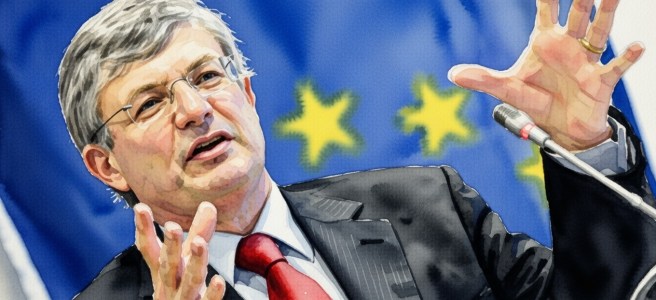
Interview of Tonio Borg, former EU Health Commissioner and current President of the ONE OF US Federation with the German weekly Die Tagespost
Professor Borg, on paper, the EU Commission has rejected the citizens’ initiative ‘My Voice, My Choice’. Why did the EU Commissioner for Equality nevertheless present this decision as a victory for the abortion lobby?
There will be no special fund exclusively for so-called abortion tourism. Instead, the Commission has referred to the existing European Social Fund (ESF+), through which the citizens’ initiative’s concerns could be addressed. However, the ESF has never been used to finance abortion services. It serves (among other things) health purposes. And abortion has not been considered healthcare until now, because pregnancy is not an illness. Now, for the first time, the Commission has officially classified abortion as a health service.
And it is not allowed to do so?
According to the EU treaties, issues such as abortion and euthanasia fall within the exclusive competence of the Member States. If there is no European fundamental right to abortion, how can states be obliged to co-finance abortions in other countries using EU funds? This clearly contradicts the principle of subsidiarity. If the Commission extends its powers beyond its remit, it sets a dangerous precedent. Today it is abortion, tomorrow it could be tax or foreign policy.
What does the Commission’s decision change in concrete terms?
In future, individual EU Member States will be able to apply for ESF+ funds to finance abortions for women from other Member States where such procedures are not permitted. Countries with liberal legislation could thus become abortion meccas and enrich themselves with EU funds.
For all Member States, this means that if abortions are now co-financed through the ESF+, all Member States will be forced to finance something that is illegal or strictly regulated in individual Member States. This affects not only Malta or Poland, where abortion is very strictly regulated, but also Italy, for example. There, abortion is not permitted in the last three months of pregnancy, whereas in other countries it is. Why should Italy now indirectly co-finance it when its own citizens are doing abroad what is prohibited in their own country? This makes no sense, either politically or demographically – especially in view of declining birth rates throughout Europe.
Why did the Commission choose this path instead of simply implementing the ‘My Voice, My Choice’ demand?
If the European Commission had proposed its own legislative framework for financing cross-border abortions, the Parliament and the Council would also have had to agree. But such a legislative initiative would probably not have achieved unanimity in the Council of Heads of State and Government. And so a formal legislative initiative was avoided – and with it, scrutiny by the Council and Parliament. Instead, the Commission is simply reinterpreting the rules and can start distributing the money accordingly. As if the European Treaties depended on the Commission’s interpretation. It’s all rather hypocritical.
Harsh words.
If the ESF+ could have been used by Member States to fund abortion from the outset, why did the Commission not point this out to the organisers when they registered the citizens’ initiative? Why were they allowed to collect signatures first? Only after the collection was completed was this route invented in order to be able to say an official ‘no’ but a de facto ‘yes’.
Overall, it still sounds as if this decision will not have a huge impact for the time being. It is also not yet clear whether individual Member States will participate at all.
It is certainly not the same as if there had been a new European financial instrument for cross-border abortions. In this sense, the initiators of ‘My Voice, My Choice’ have indeed lost in part. Nevertheless, the Commission has agreed in principle that EU money can go to abortion services, which it classifies as a health service. And that is dangerous, because it is a small crack in the door that can be widened later.
Incidentally, shouldn’t the EU Health Commissioner have been involved in the citizens’ initiative, given that this is supposedly a health service?
Exactly. Instead, it was Equality Commissioner Hadja Lahbib who was in charge. The Health Commissioner is currently Olivér Várhelyi from Hungary. They deliberately kept him away from the issue. I was Health Commissioner myself for two years, so I know how these things work. In contrast, Equality Commissioner Hadja Lahbib publicly supported the ‘My Voice, My Choice’ initiative from the outset, even before the Commission had made its decision. Someone in her position should not do that. It’s like a judge saying before the trial how he will rule in the end. That’s unfair. When the ‘One of Us’ citizens’ initiative was negotiated – and rejected – twelve years ago, no commissioner supported it.
Do you expect resistance from the Member States?
States can exert political pressure or take the Commission to the European Court of Justice. Whether this happens depends on political will. Legally, a lawsuit would be possible.
Aren’t such decisions exactly what EU-critical parties constantly warn against?
That’s right. It’s grist to the mill for EU critics, because they can point to the decision and say: Look, we told you so, the EU is interfering in national affairs. Years ago, I fought for Malta’s accession to the EU, while the socialists were against it, and I still believe in the European project. But decisions like this will ensure that parties with extreme positions on European policy become stronger.
Looking at the ideological development of the debate, it seems that the arguments of those in favour of abortion have finally prevailed. Abortion is increasingly equated with women’s rights. The embryo hardly plays a role anymore.
Nevertheless, there is hope. At an event organised by ‘One of Us’ in the European Parliament on the subject of motherhood last October, several women spoke publicly about their experiences with abortion. Many said they had felt under economic or social pressure and had not felt free. The event, which was intended to show that we are not simply against abortion but above all in favour of motherhood, was very well attended, with the majority of participants being young people. Even if pro-life positions are currently in the minority, minorities can also influence political developments. All is not lost!
 one-of-us.org