
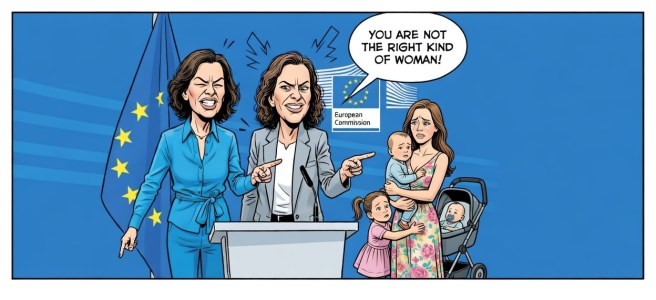
On 8 March, the media and politicians bombard us with statements about ‘International Women’s Day’, a secular holiday that was first celebrated in the Soviet Union in the 1920s and now, a hundred years later, suddenly seems to play a major role in the EU’s official calendar of celebrations. Is this a sign of a certain kindred spirit?
Ideological feminism is perpetuated and institutionalised by these celebrations, just as it is by the appointment of (almost always female) ‘equality ministers’ in almost all governments, or a dedicated ‘equality commissioner’ in the European Union.
However, on closer inspection, it quickly becomes apparent that this ideological feminism does not take into account the needs and interests of all women, but rather represents a narrow and fixed image of women that does not correspond to the reality of many women’s lives.
Essentially, this type of feminism, which is primarily advocated by socialist or communist political parties, is downright ‘anti-female’: it hates and despises everything that is typically female, especially women’s ability and calling to motherhood, and glorifies everything that is typically “masculine”: career, trouser suits, and unfortunately also a certain tendency towards selfishness and violence, as is particularly evident in abortion.
In essence, feminism wants to turn women into men. Should it not more appropriately be called as “female masculinism”?
The hatred and contempt that mainstream feminism shows towards women who do not conform to its prescribed role model is clearly evident in the way these women are talked about:
 one-of-us.org