
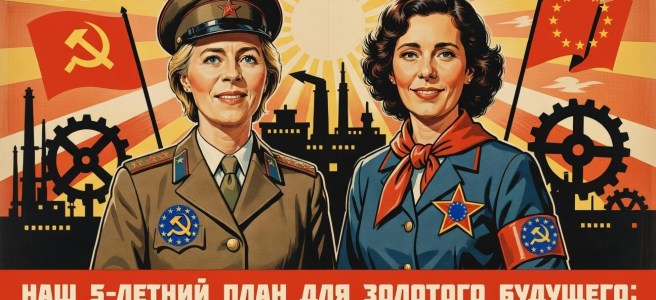
In the Soviet Union, of ill-famed memory, social progress was driven by so-called five-year plans, which were drawn up by the government bureaucracy and rubber-stamped by a sham parliament. In the People’s Republic of China and other communist dictatorships, this is still the case today. It is not society that is meant to influence political events; rather, the political elite seeks to control social life.
The European Commission has long been following this example when it sets itself a multi-annual work programme. This work programme then forms the basis for further planning, such as the “Gender Equality Strategy 2026-2030” presented a week ago, a gift from the Commission to its grateful citizens to mark “International Women’s Day” (a tradition also adopted from the Soviet Union).
It is interesting to note that this strategy extends into the term of the next Commission, whose activities are apparently already being influenced. It would therefore seem that either – entirely in the Soviet mould – the possibility of a change in political power is being ruled out from the outset, or at the very least the aim is to ensure that whatever is decided today must be continued by future leaders. Welcome to “ourdemocracy” in the EU in 2026, which is being fortified and made resilient against unwelcome election results.
The ideological feminism that the European Commission is thus elevating to the status of a binding neo-socialist doctrine for the state and society is by no means dissimilar to Soviet communism and can, in part, be traced back to the same origins. It is only thanks to the historical blindness of the social mainstream that this is noticed by only a few and goes almost entirely unnoticed.
The “equality” between the sexes, which the Commission has set as a target, amounts – just as in socialism, and even more so than there – to the levelling out of natural differences: for men and women are by nature different, and it is precisely this ‘flaw’ that one feels compelled to correct: through quotas for women on supervisory boards, interference with freedom of expression and speech, and, of course, by using funds diverted from the EU budget to – for ultimately, it is the possibility of pregnancy, motherhood, or even the ‘outdated role model’ of a housewife and mother that is the greatest obstacle on the path to the longed-for gender equality, the unisex society in which women are finally like men.
The abortion issue is thus the cornerstone of the gender-socialist doctrine, just as the nationalisation of the means of production was in communism. Both ideologies promised a social utopia, which, unfortunately, could only be achieved by force.
Gender socialists are simply not concerned with providing concrete help to specific women in need (which is why they never do so), but are pursuing an ideological project for which they are prepared to shed the blood of other people: that of unborn children.
The strategy would almost be entertaining to read, given its absurd detachment from reality, were it not for the fact that it is meant to be taken deadly seriously and that the Commission will actually attempt to implement it.
Right from the introduction, a bright future is painted:
“Gender equality is a core value of the EU and an aspiration uniting European institutions, governments and the public. The EU has made significant strides towards achieving a Union of Equality and is a global champion of women’s rights. Europeans enjoy some of the most advanced legislation worldwide to protect their rights and combat gender-based violence.
Gender equality is indispensable for achieving the EU’s strategic goals, from upholding democracy and the rule of law to fostering social cohesion and bolstering security and competitiveness. Equal rights and opportunities for women and men, in all their diversity, are instrumental in sustaining Europe’s vibrant democracy, strengthening representativeness, institutional legitimacy, and democratic decision-making. Inequality wastes talent, blocks
careers, and reduces productivity. Improving gender equality in the EU could lead to a 9.6% increase in GDP per capita and an additional 10.5 million jobs by 2050“.
These are more or less the same phrases that were used in the Soviet Union to promise the final victory of socialism, or that have helped to sell the ill-considered policies that are at the origin of Europe’s current social and economic crisis. One cannot help but wonder whether this increase in GDP is intended to offset the loss of prosperity caused by the Commission’s other planned-economy initiatives, such as the Green Deal, the planned phase-out of fossil fuels, the switch to electric mobility, or emissions trading? Was it not also claimed that all these measures would lead to economic growth and new jobs?
At the end of the day, it is, of course, clear to anyone with all their wits about them that “gender equality” is, above all, an ideological and utopian project, the implementation of which will certainly not create prosperity, but will in fact jeopardise it. A measure such as the Directive on gender balance on corporate boards, which encroaches on corporate autonomy and requires companies to fill key leadership positions not based on competence and suitability but according to criteria that are clearly irrelevant, will certainly not have a positive impact on the competitiveness of the affected companies; rather, it will undermine it. Only if one is extremely fortunate might this weakening of competitiveness be manageable in individual cases for an otherwise well-positioned company; as a general policy, however, “gender quotas instead of competence” is a surefire way to destroy thriving economies.
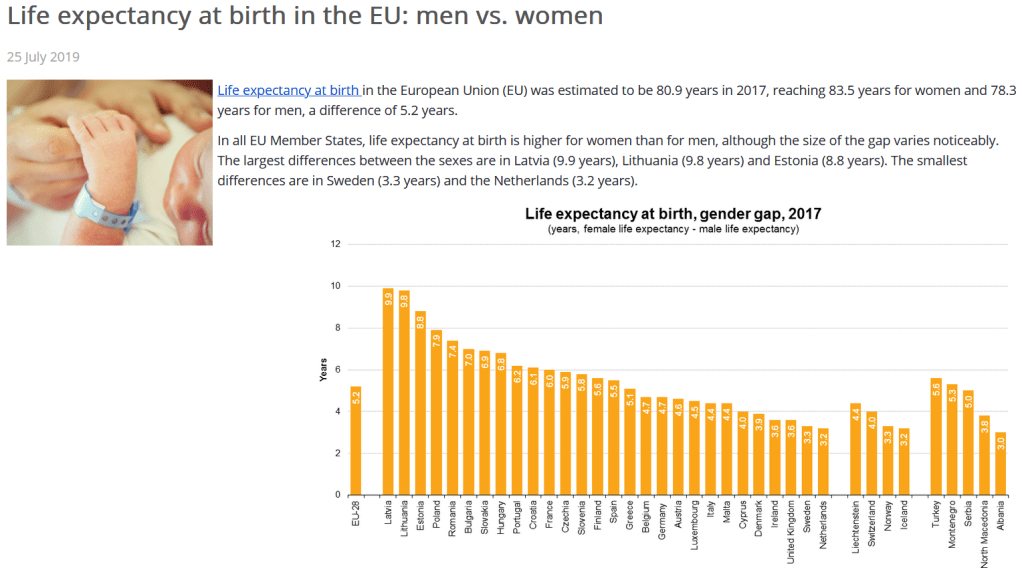
The same applies, of course, to everything in the strategy concerning “sexual and reproductive health.” Of course, this has nothing to do with health at all (why would it? In all European countries, women have a higher average life expectancy than men, which proves that the concern that they might be subject to any kind of “discrimination” in this regard is pure fantasy. No, it is about eradicating the natural difference between the sexes—and to achieve this goal, one accepts not only harm to women’s health (who still remembers that Ireland, when abortion was still banned there, had the lowest maternal mortality rate?), but also economic harm: A society that legalizes abortion, in which women are forced into the workforce and children into daycare, and in which the birth rate falls below 2.1 children per woman, is a society that invests too little in its future. In the first five or ten years, the economically damaging consequences of such a policy may not yet be noticeable, but after one or two generations, they are virtually irreversible and beyond repair.
Europe has already passed the point where the harmful consequences of feminist ideology are as evident to everyone as the economic collapse of the Soviet Union was in 1990—but the Commission’s new strategy shows that the EU’s political elite simply refuses to acknowledge the failure of its ideology: they are trying to avoid cognitive dissonance, denying the obvious, and sugarcoating reality to confirm to themselves just how right all the wrong decisions they made in the past actually were.
In the field of health policy, the Strategy asserts that it will address the discrimination of girls and women with regard to healthcare. But what discrimination is there to address, when in fact, according to the EU’s own Eurostat statistics, women have a life expectancy that is, in the EU average, more than 5 years higher than that of men (ranging from more than 3 years in the Netherlands to more than 9 years in Latvia)? Is this alleged “discrimination” really more than a red herring?
The problems that the Strategy seeks to address seem to exist only in the phantasy of its authors, not in reality.
It fits well into this context that the Commission’s surprising and apparently false claim in its opinion on the “My Voice, My Choice” abortion initiative—that European Social Fund resources may henceforth be used by member states that so desire to finance abortion—appeared just a week later in the gender-socialist five-year plan as well. The whole thing looks like a rigged game and is once again somewhat reminiscent of the Soviet Union, where there was also a “civil society” tightly organized and financed by the state, whose wishes and goals always aligned with those of the state power.
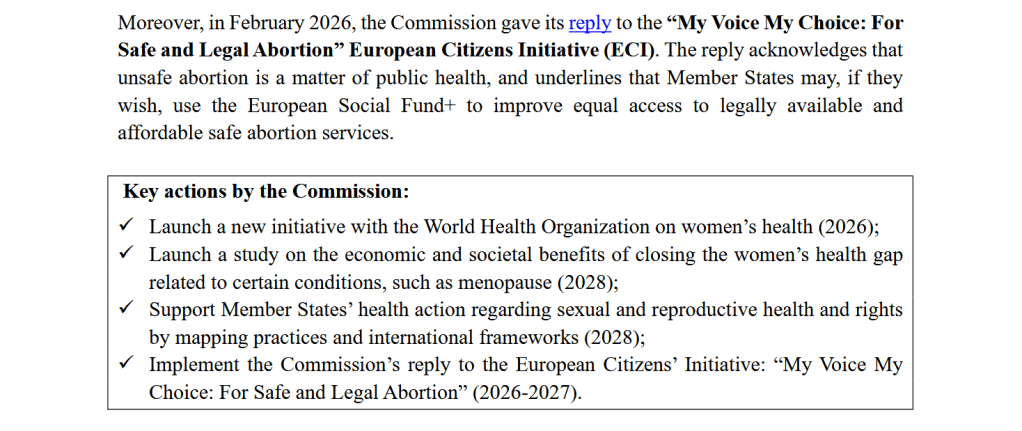
But even if the Commission “underlines” this, the statement remains incorrect. ESF funds can (among many other things) be used to improve access to health care, but the intentional killing of a healthy child in the womb of a healthy mother for the sole reason that the mother wishes to get rid of the child is not “health care,” but an act of killing. The “implementation” of the Commission’s temerarious announcement would be illegal.
Even in its detachment from reality and its Orwellian style of language, the European Commission’s gender socialism proves to be intellectually closely related to Soviet communism.
 one-of-us.org