
“When I use a word,” Humpty Dumpty said in rather a scornful tone, “it means just what I choose it to mean—neither more nor less.”
“The question is,” said Alice, “whether you can make words mean so many different things.”
“The question is,” said Humpty Dumpty, “which is to be master—that’s all.”
(Lewis Carroll: Through the Looking-Glass)
Someone who is otherwise known to be a brilliant lawyer and very committed to protecting the right to life of the unborn has told us that in his opinion it is difficult to dispute that a State may include abortion within healthcare, even under EU law, insofar as this practice is not explicitly excluded and the EU only has a supporting competence in this area. As a consequence of this, he opines that the European Social Fund (ESF+) could be used to fund abortions.
Now, from an ontological point of view, it is clear that abortion is not healthcare. In a legal culture based on legal positivism, it is true (or rather, it is broadly accepted) that a State could adopt a definition of “healthcare” that includes abortiion. The EU could also adopt such a definition, but so far it has never done so. And if a given Member State defines healthcare to include abortion, while the EU doesn’t, then very clearly the ESF+ cannot be used to fund abortions, despite the claims made by the European Commission in its controversial statement on the ECI “My Voice, My Choice”.
To understand this, it is necessary to take a closer look at Regulation (EU) 2021/1057 establishing the European Social Fund Plus (ESF+), and in particular Articles 3 and 4 thereof.
Article 3 defines the “General Objectives” of the Fund, which comprise not only “high employment levels, fair social protection and a skilled and resilient workforce ready for the future world of work, as well as inclusive and cohesive societies”, but also “equal opportunities, equal access to the labour market, fair and quality working conditions, social protection and inclusion, in particular focussing on quality and inclusive education and training, lifelong learning, investment in children and young people and access to basic services.”
Access to “healthcare” is not specifically mentioned, but it is thought to be included in “basic services” – provided of course it is “basic” healthcare.
These general objectives are then spelled out in further detail in Article 4, which comprises a long itemised list of “Specific Objectives”. Rather far down in this list – item k) in a list that runs from a) to m) – is the Specific Objective that the Commission claims could be used to justify the use of ESF+ Funds to finance abortions in Member States where they are legal (and considered to be “healthcare”). The full wording is as follows:
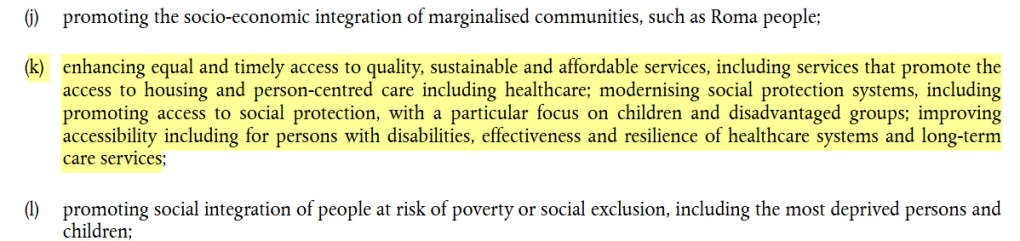
When looking at the highlighted text, it becomes immediately clear that “healthcare” is not at the focus. Instead, “healthcare” is included in “services that promote the access to housing and person-centred care”, which in turn are included in “access to sustainable and affordable services”.
In other words, “healthcare” is not even a “Specific Objective” of the ESF+ in its own right, but it is just a sub-item of a sub-item – in a list of 13 items, rather far down towards the end.
This all does not mean that the ESF+ cannot be used to finance healthcare, but it does put the notion of “healthcare” into context.
But the question is of course what “healthcare” is, and who gets to define it.
According to the learned frind whom we have mentioned above, it “is difficult to dispute that a State may include abortion within healthcare, even under EU law, insofar as this practice is not explicitly excluded and the EU only has a supporting competence in this area”. In other words, a Member State may define “healthcare” however it likes. But does it follow that that Member State would thereby acquire an entitlement to get support from the ESF+ for whatever that definition comprises?
To find the right answer to that question, it suffices to imagine the absurd consequences that would follow if a wide definition of “healthcare” by a Member State automatically triggered such an entitlement. Article 4 (1) of Regulation 2021/1057 comprises a long, elaborate list of itemized “Specific Objectives” for the ESF+, yet it is only one word, a sub-item of one sub-items in a list of 13 such “Specific Objectives”, that would, much like a magic spell, bring everything within the scope of the objectives to be financed by the Fund? A Member State would enjoy unlimited freedome to bring whatever it likes within that scope, just because it unilaterally claims it to be part of its policy on “healthcare”?
This would effectively transform the European Social Fund into a “European Fund for Everything”. And who knows, maybe there are some more “magic words” that could be invoked in this way, if perchance a funding instrument fails to comprise the term “healthcare”.
It seems fairly obvious that the ESF+ (and, more generally, the EU) cannot function in this way. This is why in EU law we have the long-established principle of “autonomous interpretation”. If a legal act of the EU uses a term like “healthcare”, that term has the meaning that EU law assigns to it, not the meaning that a Member State chooses to give it.
With regard to Regulation 2021/1057, it should be noted that that Regulation does not comprise its own definition of healthcare. The term therefore has either the meaning it has in common parlance, or it is to be interpreted according to the only legal definition of it comprised in the EU acquis, which is found in Article 3 (a) of Directive 2011/24 on on the application of patients’ rights in cross-border healthcare:

That definition, which is highly relevant, as it deals precisely with the cross-border funding of healthcare, is very much in line with what common parlance understands by that term: diagnosis, prevention, and healing of illnesses. The killing of unborn children is not part of it.
 one-of-us.org