
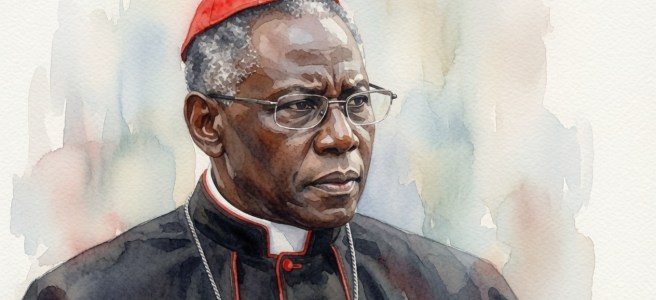
Keynote address by Cardinal Robert Sarah at an event at the European Parliament in Brussels – FULL TEXT!
The linguistic confusion surrounding ‘new rights’ and a reversal of reason lie at the heart of the crisis facing the West, which has lost sight of the meaning of its own civilisation. A call to return to logos and to the truth of the person, the family and peoples in the lectio magistralis on Europe and Africa: In Dialogue with Cardinal Robert Sarah, delivered today, 15 July, in Brussels, in Room SPAAK 5B1 of the European Parliament, at the invitation of the ECR Group (European Conservatives and Reformists), together with SOS Chrétiens d’Orient and Pro Vita e Famiglia.
Source: the Italian Catholic online newspaper ‘La Nuova Bussola’ and the livestream from ‘Pro Vita e Famiglia’ (see video below).
1. Logos, Language and Contrasting Worldviews
Dear Mr President,
honourable Members of the European Parliament,
friends of “Pro Vita e Famiglia”,
ladies and gentlemen,
I thank you for the invitation to share with you here – in the House of the European Peoples – some thoughts that are close to my heart as a son of Africa and a shepherd of the Catholic Church. I have not come to you with a mere formal address, but with a question that I consider crucial for the future of our two continents: Can we still understand one another? Do the words we use – ‘human rights’, ‘dignity’, ‘development’, ‘freedom’, ‘health’, ‘gender’, ‘family’ – still carry the same meaning for those who utter them in Brussels, Strasbourg, Kampala or Conakry?
Last January, during a meeting with the Diplomatic Corps accredited to the Holy See, Pope Francis made a remark which I would like to use as the key to understanding my remarks today. The Pope said: “We need words to once again express certain realities unequivocally. Only in this way can a genuine dialogue, free from misunderstandings, be resumed” (1). This shows us that the crisis we are experiencing – a geopolitical crisis, a crisis of rights, a crisis of multilateralism – essentially goes beyond mere language: it is a crisis of the ‘logos’, of reason.
The dossier prepared for this meeting – which I have studied in detail – clearly documents how, in relations between the European Union and Africa, words today do not serve to reveal reality, but rather to obscure it or even turn it on its head (2). Terms such as ‘sexual and reproductive health’ are often used synonymously with access to abortion. ‘Gender equality’ is sometimes used to mean a deconstruction of the gender difference between men and women – a difference that is inscribed in the human body. ‘Human rights’ are invoked in the context of African countries to impose legal categories that are alien to our history, our faith, our culture and our anthropological conception of humanity. If words no longer mean what they say, how can there be genuine dialogue? How can Africa trust a Europe that expresses itself in ambiguous and double-meaning ways?
This is not a matter of academic hair-splitting, but a political matter – a question of truth and sincerity in human relations – which is of the utmost importance. A treaty, a resolution or an action plan that makes use of imprecise and ambiguous terms does not serve as an instrument of cooperation, but as a tool of perversion and the covert exercise of power – of cultural and economic neo-colonialism. Whoever controls the meaning of words effectively determines the outcome of negotiations, often without the other side even realising it. This is precisely what is happening at present, and this is precisely what I wish to address in this lecture in the light of the Gospel and reason (3).
I would like to link this analysis to a text which I consider to be exceptionally relevant today: the encyclical ‘Magnifica Humanitas’, signed by Pope Leo XIV last May. In it, the Pope denounces the use of technocratic, manipulative and misleading language – a language which, whilst designed for the age of artificial intelligence, can, I believe, be applied to many areas of international cooperation. This language carries the risk of reducing human beings to statistical categories in the service of economic powers, rather than recognising them as free subjects endowed with transcendent dignity (4). Leo XIV calls for a way of thinking which – to use his own words – is ‘dynamic and faithful to the Gospel’ and capable of upholding the truth about the human person, even when mechanisms of power – be they economic, legal or communicative in nature – attempt to reinterpret this truth for their own ends (5). The encyclical makes it clear that this is – then as now – an anthropological question.
Here, then, is my first appeal: let us return to speaking in harmony with the truth about the person, the family and peoples – including, and above all, in the context of cooperation between the European Union and Africa.
1.1 Benedict XVI and the primacy of the ‘Logos’
To fully grasp this crisis of the word, we must trace it back to a deeper root: the crisis of reason itself. Here I must pay tribute to the prophetic insight of the great Pope Benedict XVI; he was the first – in three memorable addresses – to diagnose the evil that is now unfolding with full force.
In September 2006, in Regensburg, Pope Benedict XVI recalled that the Christian God – to take up the Greek expression of Emperor Manuel II Palaiologos (1348–1425), which he was discussing – acts ‘σὺν λόγῳ’ (‘syn logō’), that is, ‘with “Logos” ” (6). “Logos” – as the Pope explained – means both reason and word: a creative reason which is able to communicate precisely because it is reason (7). “To act unreasonably, not to act with the ‘Logos’ is contrary to the very nature of God”, he wrote, citing the Byzantine Emperor (8). This leads to a consequence which I would like to emphasise strongly before this assembly: a reason that closes itself off from the divine and relegates religion to the realm of private subcultures becomes itself incapable – to use Benedict’s words once more – of participating in the dialogue between cultures (9).
Let us apply this principle to the issue of ‘rights’, which currently dominates our European debates. When Europe constructs rights that are detached from the truth about the human person – for instance, in attempting to elevate abortion to a ‘fundamental right’ or to reduce sexual identity to a mere subjective self-creation – then reason itself becomes distorted: From an instrument for the discovery of truth, it becomes an instrument of power, capable of imposing its own viewpoint on those who do not share these premises, using the force of law and money. Pope Benedict XVI added – again in Regensburg – that a reason deaf to the divine becomes incapable of genuine intercultural dialogue, because it lays claim to establishing itself as the only possible rational culture, thereby relegating every other view of humanity – from the Christian perspective right through to that of the great African religious traditions – to the status of superstition in need of correction (10). So when a set of ideological tenets is presented to us today as synonymous with ‘modernity’ or ‘progress’, we should recognise in it not an expansion but a narrowing of reason.
Two years later, at the Collège des Bernardins in Paris, Pope Benedict XVI pointed Europe towards the path of ‘quaerere Deum’: ‘To seek God and allow oneself to be found by him – this is no less necessary today than in times past,’ he said before representatives of French cultural life (11). And he added a warning that today seems almost prophetic: ‘A purely positivist culture, which would relegate the question of God to the realm of the subjective as unscientific, would be a capitulation of reason, a renunciation of its highest potential’ (12). Christianity, the Pope went on to explain on that occasion, perceives the Word – the ‘Logos’ itself – in human speech; for a Christian, words are never merely instruments, but share in the truth they convey (13).
Three years later, Pope Benedict XVI took this reflection directly to the heart of European legislative practice in the German Bundestag. “Where positivist reason regards itself alone as the sufficient culture and relegates all other cultural realities to the status of subculture, there it diminishes the human person; indeed, it threatens his or her very humanity.” (14). And he asked the German legislators: “How can reason rediscover its greatness without slipping into the irrational?” (15). It is precisely this question that I would like to put to you today, honourable Members of Parliament: Is European legislation, which claims to be ‘neutral’ with regard to anthropological views – yet in fact, through treaties, aid programmes and trade regulations – impose a specific and controversial view of humanity worldwide – not in fact be sliding precisely into that very irrationality against which Pope Benedict XVI warned us? These three significant addresses form the bridge I wish to build to today’s topic: a critique of those forms of ‘ideological colonisation’ which make use of international law as well as European or international funding to impose questionable and controversial anthropological concepts on peoples who have not chosen them (16).
1.2 The Three Popes and Ideological Colonisation
This primacy of the ‘Logos’, which is threatened by legal and economic positivism, finds its most immediate and painful application, of all things, in the question of gender ideology. It was Benedict XVI who, in his final Christmas address to the Roman Curia in December 2012, provided us with the theological key to understanding this. Referring to the reflections of the then Chief Rabbi of France, Gilles Bernheim, the Pope recalled the famous words of Simone de Beauvoir: ‘One is not born a woman, but becomes one’ – and he commented: “Human beings deny that they have a nature determined by their physical being, a nature that characterises the human being as a man or a woman […] They deny their own nature and decide that it is not given to them as a predetermined fact, but that they themselves create it” (17). From this he drew a serious conclusion: “Where freedom of action becomes the freedom to create oneself, one inevitably ends up denying the Creator himself” (18). “Whoever defends God,” Benedict concluded, “defends humanity” (19).
This theological key enables us to gain a deeper understanding of categories such as S.O.G.I. (Sexual Orientation and Gender Identity) and C.S.R.H.E. (“Comprehensive” sex and reproductive health education), which feature so prominently in treaties between the European Union and African states (20) . These are not neutral categories; they represent the political and legal application of precisely that denial of pre-established nature – that rejection of the Creator – of which Benedict spoke.
Please note, honourable Members and dear friends, that these categories do not appear in isolation in a single document, but recur systematically – in parliamentary resolutions, trade protocols and sectoral action plans – to the point where they form a genuine system (21). A system does not arise by chance; it grows out of a coherent worldview – namely, that secularised and irrational worldview (irrational in the technical sense, contrary to the ‘Logos’) which I described at the outset.
Pope Francis, for his part, has given this system – this phenomenon – a name that has now entered common parlance: ‘ideological colonisation’. At a meeting with families in Manila in January 2015, he spoke words that deserve to be heard once again in their entirety: ‘Let us guard against new forms of ideological colonisation. There are forms of ideological colonisation that aim to destroy the family […] They do not arise […] from prayer, from an encounter with God […] they come from outside, and that is why I call them forms of colonisation’ (22). A few days later, at the press conference during his return flight, Francis was even clearer and recalled the complaints of African bishops who had gathered for the Synod: “This is ideological colonisation: one imposes an idea on a people that has nothing to do with that people […] it is exactly the same as when certain conditions are imposed in exchange for certain loans” (23).
I would now like to apply this magisterial framework – which encompasses Benedict XVI, Francis and Leo XIII – in three stages to three major themes: the dignity of the person and religious freedom; the self-determination of peoples; and Africa and its relations with Europe and the Church.
2. The dignity of the human person and religious freedom
2.1 Ontological principle: the dignity of the person and the ‘Logos’
Let us begin with the foundation of everything: the dignity of the human person. ‘Magnifica Humanitas’ – a title which is in itself a manifesto – reminds us that the human person, created by God, is indeed ‘magnificent’ and cannot be reduced to a statistical figure, a productive function or a shifting subjective preference (24). Every social, economic and technological order – as the encyclical emphasises – must be measured against this dignity and against the person’s vocation to communion with God, and not the other way round (25).
The first and most fundamental consequence arising from this ontological principle is religious freedom. It is not merely one right amongst others, simply added to the list; it is – as Pope Leo XIV recalled in his aforementioned address to the Diplomatic Corps – the root of every other freedom, since it concerns the human person’s constitutive relationship with truth and with God (26) . To deny it, to restrict it or – worse still – to exploit it for foreign policy purposes is to strike at the very core of human dignity.
It is significant that Pope Leo XIV explicitly linked his first encyclical to the social teaching of Pope Leo XIII (27). *Rerum Novarum* (1891) defended the family, work and freedom of association, and presented the Church as the guarantor of a holistic view of the human person in the face of the ideologies of that time – back then, socialist collectivism and individualistic liberalism; today, I believe, economic technocracy and gender ideology (28). This continuity between the two popes is no coincidence: it makes it clear to us that the dignity of the person, even before it is an axiological principle – that is, a value to be promoted – it constitutes an ontological principle: a fact of being that no parliamentary majority and no international treaty can redefine. This distinction between the ontological and the axiological is not merely a sophistry of theological scholarship; it forms the keystone of my entire address. If dignity were merely a value, it could be negotiated, weighed against other interests or set aside in favour of competing values – such as economic efficiency, geopolitical stability or electoral favour. If, on the other hand, dignity is an ontological reality, it precedes all political considerations and judges them: no parliament – whether European or African – creates it; rather, every parliament worthy of the name is obliged to recognise and protect it.
2.2 Abortion and sexual and reproductive health and rights [SRHR]: from the right to life to the supposed right to end life
It is precisely on this ontological terrain that one of the most serious undermining of the ‘Logos’ is taking place today. In June and July 2022, the European Parliament adopted resolutions calling on the Commission and the Member States to prioritise ‘universal access to safe and legal abortions’ in the Union’s external relations, and proposing that abortion be included among the fundamental rights enshrined in the Charter of Fundamental Rights of the European Union (29).
It is here that the undermining of the ‘Logos’ – reason – reaches its most dramatic point: a lack of access to abortion is defined as ‘violence’, whilst the unborn child – the weakest and most innocent among us – is denied any voice, any representation and any right (30). The terms ‘health’, ‘rights’ and ‘freedom’ thus no longer denote specific realities – to take up once more the expression of Pope Leo XIV – but become rhetoric in the service of eliminating the weakest (31). This is not merely one opinion amongst many; it is the most radical denial conceivable of that ontological principle to which I have just referred – for it fundamentally denies that the unborn child is a person, or even the hypothesis that it might in fact be one.
I would like to add a consideration that directly concerns religious freedom. A legal system that elevates abortion to a fundamental right in treaties and external relations – and seeks to make cooperation with third countries contingent upon this – effectively compels states, religious communities and staff in the health and education sectors to subscribe to a conception of the human person that is incompatible with their religious convictions. This is not neutrality; it is coercion and unacceptable oppression. It amounts to imposing a particular anthropology on communities that do not share this view through legal and financial means; this constitutes a genuine violation of freedom of religion and conscience – that freedom which Pope Leo XIV reminded us is the root of every other freedom (32). It is noteworthy that the legal systems of many African countries continue to maintain, in their constitutional law, an explicit link between human dignity and the protection of unborn life – a link which Europe, by contrast, has severed in many of its own legal systems. Article 26 of the Kenyan Constitution states that ‘the life of a person begins at conception’ (33). Article 22 of the Ugandan Constitution stipulates that ‘no person shall have the right to terminate the life of an unborn child unless permitted by law’ (34). This is not a backward-looking relic, but rather a piece of legal wisdom – rooted in both natural law and African religious traditions – which the West should reconsider rather than correct. Significantly, the Kenyan Court of Appeal emphatically reaffirmed this constitutional principle only this year, rejecting an interpretation that sought to establish abortion as a fundamental right (35). This is a concrete illustration of what I mean by the self-determination of peoples in harmony with human dignity: a continent which, despite a lack of material resources, has not forgotten what it means to be human.
2.3 Gender, Education and the Redefined Person
The third aspect of this reversal concerns education – that central sphere in which a civilisation passes on the truth about itself to new generations. Article 40.6 of the Africa Protocol to the Samoa Agreement – the framework agreement currently governing relations between the European Union and the states of Africa, the Caribbean and the Pacific – obliges partner governments to ensure access to ‘comprehensive sexuality and reproductive health education’ (CSRHE), with explicit reference to international technical guidelines on sexuality education (36). The European Union, for its part, sets out an openly ‘gender-transformative’ approach and stipulates that at least 85 per cent of the Union’s new external policy measures must incorporate gender equality objectives (37).
Here, the criticism of gender ideology expressed by Pope Benedict XVI – to which I have already referred – can be directly applied: education is becoming a laboratory, in which children are taught to regard their sexual identity as purely fluid and self-determined, detached from the body, family history and relationships – in contradiction to that ‘Logos’ of creation of which Pope Ratzinger spoke in Regensburg, Paris and Berlin (38). We must not shy away from calling a spade a spade, as Pope Leo XIV admonished us: when a ‘protocol’ or a technical ‘action plan’ imposes a uniform educational model on human sexuality upon an entire continent – without genuine consultation with the peoples concerned – then we are once again witnessing that form of oppressive ideological colonisation which Pope Francis has so often and forcefully denounced (39).
In this case, it manifests itself in the way that educational programmes and conditional aid are being used to interfere with the cultural fabric of African nations, with the aim of redefining the individual and the family according to secularised Western standards that are alien to the history of these peoples (40). I therefore ask you, honourable Members – respectfully, yet with great emphasis – not to reduce the terms ‘man’, ‘woman’, ‘marriage’ and ‘family’ to social constructs that can be manipulated at will according to ideological fashions, but to uphold them as ontological facts of reality – a reality that is created and not produced by human beings themselves – and, for believers, as truths of biblical revelation. This is precisely what Pope Leo XIV means when he calls for words to once again express specific realities (41).
3. The self-determination of peoples
Article 1, paragraph 2, of the Charter of the United Nations lists as one of the Organisation’s purposes the development of friendly relations among nations based on respect for the principle of equal rights and self-determination of peoples (42). The OECD [Organisation for Economic Co-operation and Development] principles on aid effectiveness cited in the dossier reaffirm that international co-operation must be guided by the priorities set by the recipient countries, rather than having these imposed from outside (43).
From this principle follows a conclusion which I wish to emphasise strongly: respect for a people’s religious and cultural history – which is all the more commendable when it protects the family, life and the transmission of the faith – is not an obstacle to development, as is sometimes suggested in the corridors of Brussels, but a fundamental imperative of justice (44). Human dignity and religious freedom also have a communal and historical dimension: a people has the right to live, preserve and pass on its religious, cultural and family traditions, just as the individual has the right to profess his or her faith.
It is worth recalling here that Christianity is neither a recent import to Africa nor a remnant of European colonialism, as is sometimes claimed in certain secularised circles. Long before Europe evangelised sub-Saharan Africa in the modern era, North Africa and the Horn of Africa had already given the universal Church some of its greatest teachers: Tertullian, Cyprian, Athanasius and, above all, Augustine of Hippo – whose reflections on the relationship between faith and reason have shaped theology and the whole of Western culture for centuries, including – and this is no coincidence – Pope Benedict XVI himself. Ethiopia has maintained an unbroken Christian tradition since the fourth century. So when we speak of the religious self-determination of the African peoples, we are not defending a form of ‘tribal particularism’ set against a supposed European universalism; rather, we are defending the freedom of a continent which, from the very beginning, has helped to shape that Christian ‘Logos’ whose memory Europe now risks losing. On closer inspection, this calls into question the implicit narrative underlying certain forms of development cooperation – the narrative that regards Africa as the eternal pupil and Europe as the true teacher. Church history teaches us, on the contrary, that the gift of faith has always been reciprocal and that Africa has just as much to give back as it has received.
Here, Pope Benedict XVI – once again in his address to the Bundestag – a crucial insight: that of the ‘ecology of the human person’ and of natural law – a law that precedes positive political power and judges it from the outside (45). ‘Law is not merely a product of the legislator’s will; it must recognise a truth about the human person and society that no parliament can define at will’ (46). No power, however rich or influential it may be, can claim for itself the right to redefine the meaning of ‘human rights’ for other peoples in a way that contradicts their moral and religious conscience. Such an approach does not promote human rights, but rather denies their very foundation: the dignity of every people, to be the subject, not the object, of its own history.
To this principle I would like to add a second cornerstone of the Church’s social teaching, which sheds essential light on our topic: the principle of subsidiarity. In the encyclical *Centesimus Annus*, John Paul II recalled that a higher-level community must never usurp the initiative and responsibility of subordinate communities by their powers; rather, it must support them in times of need and help them to coordinate their actions with those of other social forces in the interests of the common good (47). Applied to international relations, this principle means that the European Union – for all its good intentions – does not have a mandate to reshape the family law, criminal law or education systems of sovereign African states from the outside; its role consists rather in supporting these states, at their request, in achieving their own legitimate objectives. A reversal of this order – that is, the claim that a higher, supranational authority should regulate the moral and family life of peoples down to the smallest detail – is not subsidiarity, but its exact opposite: a form of ideological centralisation which the Church’s social teaching has always condemned, regardless of its origin.
4. Africa: Needs, Challenges and the Contribution Expected from the West and the Church
4.1 The European Union’s System of Conditionality
We must acknowledge the existence of a ‘three-tier system’ through which the principle of self-determination is – in practice – circumvented (48). At the normative level are the aforementioned European Parliament resolutions on abortion and LGBT+ rights (49). At the second level – that of legal treaties – lies the Samoa Agreement; it contains a priority clause capable of imposing conditions on the entire framework of relations between the European Union and the group of states in Africa, the Caribbean and the Pacific (ACP states) (50). At the third level – the financial and trade level – we find the Neighbourhood, Development and International Cooperation Instrument (NDICI), the proposal COM(2025)0551 currently under discussion, and preferential trade arrangements (51).
A specific case – that of Uganda – illustrates well how these three levels interlock (52). In its resolution of 20 April 2023, the European Parliament called on the Commission to use all available diplomatic, legal and financial means to dissuade the Ugandan President from bringing into force the law passed by the country’s parliament; it also urged the Commission, should the law come into force, to examine whether Uganda should be stripped of the trade preferences granted under the ‘Everything But Arms’ scheme, apply the clause on the ‘essential elements’ of the Cotonou Agreement and consider the EU’s global sanctions regime in the field of human rights; furthermore, Parliament called for an EU strategy for the global decriminalisation of homosexuality (53). I would like to express this in measured but firm terms: what we are seeing here is ‘ideological colonisation’ in its fullest and most demonstrable form – specifically through the use of trade and financial instruments to interfere with the criminal and family law of a sovereign state, thereby directly violating the principle of self-determination of peoples (54).
The proposed Regulation COM(2025)0551, which is currently under discussion, provides for a total budget of 200.3 billion euros (at current prices) for the Union’s external action; the indicative allocation for sub-Saharan Africa is set to more than double compared with the guaranteed minimum amount for the current cycle – from 29.18 billion euros to around 60.5 billion euros. References to the Beijing Platform for Action, the ICPD, sexual and reproductive health, and comprehensive sexuality education remain in the main text and are incorporated into the sectoral pillars of European engagement, whilst previous binding quantitative targets are replaced by an overarching ‘mainstreaming’ approach: ideological conditionality does not disappear, but becomes more pervasive and less measurable (55) . At this point, I would like to refer once again to ‘Magnifica Humanitas’: technology and economic power – as Pope Leo’s encyclical reminds us – become instruments of domination and perverse oppression if they are not guided by charity and justice (56). The Church is not calling on Europe to cease its aid to Africa – quite the contrary – but rather demands that the ‘culture of power’ be transformed into a ‘civilisation of love’ (57).
4.2 The Voices and Suffering of Africa: the Role of the Church and the West
Allow me now, in this highly symbolic place, to give a voice to those who have no voice: the Africans themselves. The dossier brings together first-hand testimonies from African government representatives, who criticise the European Union for insisting on categories such as SOGI [sexual orientation and gender identity] during negotiations – which stands in sharp contrast to Europe’s systematic refusal to discuss issues that are just as urgent for Africa, such as the return of colonial cultural artefacts; others speak openly of faits accomplis, summed up in the phrase: ‘If you do not sign, there will be consequences’ (58). These are not my words; they are taken from independent academic analyses and direct witness accounts. They make it clear that the diagnosis of cultural neo-colonialism is not merely political or ecclesiastical propaganda, but the experience of those sitting on the other side of the negotiating table (59).
It is therefore hardly surprising that, in May 2025, African parliamentarians and institutional representatives gathered in Entebbe (Uganda) – at a conference opened by President Museveni – to propose an ‘African Charter on Family and Cultural Sovereignty’. On this occasion, President Museveni explicitly referred to the Samoa Agreement and stated: “I urge you to examine that Samoa document, which addresses all the issues you are discussing here: if it actually contains what is claimed about reproductive rights, then we must distance ourselves from this absurdity and inform the European Union that we cannot be party to such an injustice” (60). These are strong words that reveal a matter of grave importance: the dignity of peoples who no longer wish to be treated as minors under guardianship, but as moral agents capable of say “no” to anything that contradicts their conception of the human person and the family.
It would, however, be unfair of me to confine myself to mere criticism. In the post-synodal apostolic exhortation *Africae Munus*, Pope Benedict XVI clearly expressed what Africa rightly expects from the West and from the Church: not ideological interference, but genuine solidarity in the service of reconciliation, justice and peace – a solidarity that is capable of accompanying without patronising, and which knows how to give without attempting to reshape the souls of these peoples in its own image (61).
In concrete terms, this means a renewed commitment to debt relief, the transfer of technologies that benefit health and agriculture, and support for those educational and healthcare institutions which the Catholic Church has maintained on the continent for centuries – often stepping in where the state is absent. It also means a joint struggle against corruption and poor governance, which weigh just as heavily on the African peoples as external interference. For the Church in the West, it means seeing Africa not merely as a mission field dependent on aid, but as a living source of faith, vocations and large, joyful families – a source from which an ageing and weary Europe can learn and draw much.
As a son of Africa, I would like to add a personal word. I have repeatedly denounced – and I reaffirm this today – the fact that certain powers are determined to impose false values through political and financial pressure: in some African countries, full-fledged ministries for gender theory have been set up in exchange for financial support (62) . I have also pointed out – referring to that visit by a UN Secretary-General to Africa who called for the decriminalisation of homosexuality as a sign of civilisation – that such absurdities must not be imposed on the poor whilst there is a shortage of hospitals, schools and drinking water (63). Africa’s material poverty robs the continent neither of its dignity nor of its right – indeed, perhaps it even gives it a stronger claim to that right – to judge for itself what is best for its children.
In 2015, during the Synod on the Family, I stated – and I do not take back a single word of it today – that gender ideology and Islamic fundamentalism, each in its own way, represent two ‘apocalyptic beasts’ that threaten to destroy not only the family but human beings themselves – the image of God (64) . Some considered this image to be exaggerated; I remain of the view that it strikes at the heart of the truth: both forces, however different they may be in origin and form, share the ambition to redefine humanity in accordance with their own goals – one in the name of supposed progress, the other in the name of a supposed return to original purity. In doing so, they deny that religious freedom and personal dignity which I have placed at the centre of this ‘Lectio’.
In conclusion, I would like to share a deep conviction that has matured within me during my many years of service to the Church: the crisis of the Church in the West and the crisis of the West itself are, at heart, one and the same crisis. Because the Church has lost its identity and its prophetic voice in many European nations, the West, too, has lost its sense of its own civilisation (65). And I would like to add: in the West, too, religious freedom is under threat today (66). Here, the three Popes to whom I have referred in this ‘Lectio’ are united in a common witness: Pope Benedict XVI defends the ecology of the human person and the family against legal positivism; Pope Francis denounces ideological colonisation and calls for genuine intercultural dialogue; Pope Leo XIV demands that words once again express specific realities, and proposes a multilateralism free from ideologies (67). I address this appeal – respectfully, but without reservation – to Europe and the Church in the West: undertake a serious examination of conscience. Listen to Africa. Respect its cultural sovereignty. Offer cooperation that is free and unburdened by ideological agendas. Be prepared to accept from Africa what it can still offer a weary West: the witness of a living faith and a sense of family – qualities that can help Europe rediscover its own ‘Logos’.
Conclusion: A return to the ‘Logos’ and to certain realities
Honourable Members, allow me to conclude where I began: with the words of Pope Leo XIV. Without words that refer to certain realities – as the Holy Father told us – there can be no genuine dialogue (68), even within the Catholic Church. And I would like to add: without the ‘Logos’, diplomacy and international cooperation degenerate into a power game concealed behind technical jargon. I would therefore like to invite the entire European Parliament and the representatives present here to engage in a genuine examination of language: to state clearly – without diplomatic ambiguity – what is actually meant when we speak of ‘human rights’, ‘sexual and reproductive health’, ‘gender’ and ‘family’; and to ask ourselves, with intellectual honesty, whether these definitions truly respect human dignity and religious freedom, or whether they betray them under the guise of seemingly neutral language (69).
In this lecture, I have sought to provide you with three interpretative keys that, like the stones of a single edifice, belong together. 1) Human dignity and religious freedom as the foundation of all human coexistence – something that no gender ideology and no so-called ‘reproductive health’ agenda can eradicate. 2) The self-determination of peoples as a space of freedom in which every people can realise this dignity within the framework of its own religious and cultural history, without being subject to conditions disguised as cooperation. 3) And finally, Africa – not as the object of a social construct devised elsewhere, but as the subject of culture, faith, suffering and hope, both for the Church and for the West itself (70). One final word, springing from the heart of an African shepherd: the history of faith on my continent teaches us that the Church often grows precisely in times of trial, and that those peoples who preserve their religious and cultural identity – in spite of all external pressure – ultimately serve the cause of true, universal brotherhood best. I do not ask the European Parliament for an act of faith, but for an act of reason: examine, with the resources of your legal wisdom, whether the words you use truly do justice to the human person, the family and the freedom of peoples. If this is the case, Africa and Europe will move forward together. Should they fail to do so, no treaty, however well-drafted, will be able to bridge the chasm that ‘betrayed words’ will have torn open between us.
Thank you very much.
Notes:
1 Leo XIV, Address to the members of the Diplomatic Corps accredited to the Holy See, 9 January 2026.
2 Dossier ‘Conditional Aid’, prepared by Pro Vita & Famiglia for the European Parliament conference, Brussels, 15 July 2026 (internal document serving as the basis for this address).
3 Ibid.
4 Leo XIV, Encyclical ‘Magnifica Humanitas’ on the protection of the human person in the age of artificial intelligence, 15 May 2026.
5 Ibid.
6 Benedict XVI, Faith, Reason and the University – Memories and Reflections, Address at the University of Regensburg, 12 September 2006.
7 Ibid.
8 Ibid.
9 Ibid.
10 Ibid.
11 Benedict XVI, Meeting with the World of Culture, Collège des Bernardins, Paris, 12 September 2008.
12 Ibid.
13 Ibid.
14 Benedict XVI, Address to the German Bundestag, Reichstag Building, Berlin, 22 September 2011.
15 Ibid.
16 See above, note 2: Dossier ‘Europe and Africa’, op. cit.
17 Benedict XVI, Address to the Roman Curia on the occasion of Christmas greetings, 21 December 2012.
18 Ibid.
19 Ibid.
20 See above, note 2: Dossier ‘Europe and Africa’, op. cit.
21 Ibid.
22 Pope Francis, Address during the meeting with families, Mall of Asia Arena, Manila, 16 January 2015.
23 Pope Francis, Press conference on the return flight from Manila, 19 January 2015.
24 See above, note 4: Leo XIV, ‘Magnifica Humanitas’, op. cit. 25 Ibid.
26 See above, note 1: Leo XIV, Address to the Diplomatic Corps, 9 January 2026, op. cit. 27 Leo XIII, Encyclical ‘Rerum Novarum’, 15 May 1891.
28 Ibid.
29 European Parliament, resolution of 9 June 2022 ‘Global threats to the right to abortion: the potential overturning of the right to abortion in the USA by the Supreme Court’ and resolution of 7 July 2022, 2022/2742(RSP) ; see also the dossier ‘Europe and Africa’, op. cit.
30 European Parliament, resolution of 7 July 2022, 2022/2742(RSP), op. cit.
31 See above, note 1: Leo XIV, Address to the Diplomatic Corps, 9 January 2026, op. cit.
32 Ibid.
33 Constitution of Kenya (2010), Art. 26(2): “Human life begins at conception”; see Kenya Law Reform Commission.
34 Constitution of the Republic of Uganda (1995), Art. 22(2): “No person shall have the right to terminate the life of an unborn child unless permitted by law.”
35 Court of Appeal of Kenya (Court of Appeal), judgement of 24 April 2026 confirming the constitutional protection of life from conception; quoted from ZENIT, “Kenya’s Court of Appeal reaffirms the constitutional protection of unborn life”, 2 May 2026.
36 Partnership Agreement between the European Union and the members of the Organisation of African, Caribbean and Pacific States (Samoa Agreement), Regional Protocol for Africa, Art. 40.6; see analysis by Human Life International, “Neo-Colonialism and the Samoa Agreement”, December 2023.
37 European External Action Service (EEAS), Gender Action Plan III – Towards a Gender-Equal World.
38 See above, note 6: Benedict XVI, Regensburg Address, op. cit.
39 See above, note 22: Pope Francis, Meeting with Families, Manila, op. cit.
40 See above, note 23: Pope Francis, Press conference on the return flight, 19 January 2015, op. cit.
41 See above, note 1: Leo XIV, Address to the Diplomatic Corps, 9 January 2026, op. cit.
42 Charter of the United Nations, Art. 1(2).
43 See above, note 2: Dossier ‘Europe and Africa’, op. cit.
44 See above, note 1: Leo XIV, Address to the Diplomatic Corps, 9 January 2026, op. cit.
45 See above, note 14: Benedict XVI, Address to the German Bundestag, op. cit.
46 Ibid.
47 John Paul II, Encyclical ‘Centesimus Annus’, 1 May 1991, no. 48.
48 See above, note 2: Dossier ‘Europe and Africa’, op. cit.
49 Ibid.
50 Ibid.
51 Ibid.
52 Ibid.
53 European Parliament, Resolution on the situation in Uganda, Texts Adopted P9_TA(2023)0120.
54 See above, note 23: Pope Francis, press conference on the return flight, 19 January 2015, op. cit.
55 See above, note 2: Dossier ‘Europe and Africa’, op. cit. 56 See above, note 4: Leo XIV, ‘Magnifica Humanitas’, op. cit.
57 Ibid.
58 Direct statements by African government representatives, compiled in the dossier ‘Europe and Africa’ prepared for this conference .
59 Ibid. 60 Y. Museveni, statement at the Conference on the Family, Entebbe, May 2025, quoted in “Watchdog Uganda”, “President Museveni calls on Africa to defend family values and secure economic sovereignty”, 9 May 2025.
61 Benedict XVI, Post-Synodal Apostolic Exhortation “Africae Munus” on the Church in Africa in the service of reconciliation, justice and peace, 19 November 2011.
62 R. Sarah, statements collected on Wikiquote, entry ‘Robert Sarah’.
63 R. Sarah, statements reproduced in Wikipedia, entry ‘Robert Sarah’.
64 R. Sarah, address to the Synod of Bishops on the Family, October 2015; full text in the ‘National Catholic Register’, ‘Cardinal Sarah: ISIS and Gender Ideology Are Like “Apocalyptic Beasts”’, October 2015.
65 R. Sarah, interview, ‘Aleteia’, 17 April 2019.
66 R. Sarah, statements reproduced in ‘Informazione Cattolica’, 30 November 2022.
67 Cf. above, note 1: Leo XIV, Address to the Diplomatic Corps, 9 January 2026, cited.
68 Ibid.
69 Ibid.
70 Cf. above, note 4: Leo XIV, *Magnifica Humanitas*, cit.

