
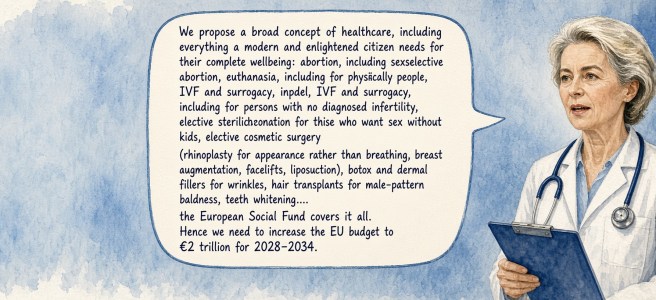
If abortion qualifies as “healthcare” and can be funded under the ESF+ as per the European Commission’s controversial response to the pro-abortion ECI “My Voice, My Choice”, then European taxpayers could soon have to foot the bill for many other controversial practices.
In September 2026, the Dutch government’s euthanasia review committee confirmed a milestone few outside medical-ethics circles had been tracking closely: the first case of euthanasia performed on a child under 12 since the Netherlands changed its law in 2024 to permit it “under very strict conditions.” The patient was a child of nearly two who suffered from several severe medical conditions, including severe cerebral palsy, a visual impairment, and frequent epileptic seizures largely unresponsive to medication. The committee concluded the doctor had acted with due care.
Before 2024, Dutch law already permitted euthanasia for those 12 and older with parental consent, and for infants under one year under the Groningen Protocol. The new 2024 regulation filled the gap in between, formally allowing the termination of life for seriously ill children aged 1 to 12. Officials expected the rule to apply to a small group of about five to ten children a year — those whose palliative care options are insufficient to relieve suffering and who are expected to die within the foreseeable future.
Whatever one thinks of the ethics, Dutch officials have been consistent in describing this as an extension of medical care: a “health service” for patients facing hopeless and unbearable suffering with no other recourse.
That framing is worth holding up against the European Commission’s announcement, responding to the “My Voice, My Choice” citizens’ initiative, that it is possible to use EU funds to support member states’ efforts to improve access to safe and legal abortion care, specifically through the European Social Fund Plus. The Commission’s reasoning leaned explicitly on the “health service” label: its justification aligned with controversial WHO statements classifying abortion as an essential health service and calling for the removal of financial barriers to it. Commissioners Lahbib and Mînzatu were careful to stress this doesn’t require new legislation — Member States could already use existing ESF+ funding, they said, so no new EU legal instrument was needed.
So here’s the question worth asking plainly: if “health service” is elastic enough to bring cross-border abortion funding within the ESF+’s reach, on what principled basis could it exclude to use the same funding for euthanasia? Both abortion and euthanasia are framed by their advocates as compassionate medical interventions decided between doctor, patient (or parent), and the state’s regulatory framework. If the Commission is willing to stretch a supportive-competence fund to cover one contested end-of-life-adjacent procedure because it’s labeled “health”, it’s fair to ask why the same logic wouldn’t eventually extend to others — and to press the Commission, now rather than after the fact, on where that line actually sits and who draws it.
Once the concept of “healthcare” is expanded beyond the diagnosis, prevention, and treatment of actual diseases, all becomes possible:
Euthanasia of physically healthy adults (Belgium)
This is real and legal. Belgian law allows euthanasia for adults experiencing “unbearable and untreatable” suffering that can be physical or psychological — it doesn’t require a terminal illness or physical disease at all. A well-known case involved a 24-year-old woman with treatment-resistant depression and no physical illness, approved for euthanasia on psychiatric grounds alone. The Netherlands and Luxembourg allow something similar. Psychiatric-only cases remain a small share of the total (roughly 1–2%) but have drawn sustained criticism from psychiatrists themselves — a 2015 white paper signed by dozens of Belgian clinicians argued that “unbearable suffering” and “incurability” aren’t measurable in psychiatric cases the way they are in terminal physical illness, making the safeguard largely subjective. Defenders counter that three independent physicians (including a psychiatrist) must agree, a mandatory waiting period applies, and that refusing autonomy to psychiatric patients while granting it to physically ill ones is itself a form of discrimination against the mentally ill.
IVF and surrogacy
IVF is treated as healthcare almost everywhere it’s legal — on the basis of the claim that it treats a recognized medical condition (infertility) and is often at least partially covered by national health systems. Yet in fact IVF does not “cure” infertility, it just procures a child.
IVF doesn’t treat the underlying cause of infertility the way, say, antibiotics treat an infection or surgery repairs a blocked fallopian tube. A person who undergoes IVF is generally still infertile afterward in the physiological sense — the condition isn’t cured, it’s bypassed. What IVF does is produce a pregnancy despite the condition, using a different mechanism (fertilization outside the body) rather than restoring the body’s own reproductive function. That’s a real conceptual difference from most things called “medical treatment,” and it’s not just semantic — it’s the actual basis for a live debate.
There is no doubt that infertility itself is a disease. But classifying IVF as the recognized medical treatment for it — treatment being understood broadly as “the clinical response to a diagnosed condition,” not necessarily its cure – is a rather questionable framing.
A lesbian woman using donor sperm and IVF is, in the vast majority of cases, not infertile in any clinical sense — nothing is physiologically preventing her from conceiving with sperm from a male partner. What she lacks (or, in fact, does not want) is a male partner, not reproductive function. The same is true of a single heterosexual woman using donor sperm, or a gay male couple using a surrogate and donor egg. This is sometimes distinguished in the literature as “social” infertility versus “medical” infertility — and the two get treated identically by IVF clinics and, in many EU states, by public funding schemes, even though only one of them involves an actual diagnosed condition.
If the WHO’s infertility-as-disease definition were doing real medical work, one would expect eligibility to track diagnosis, the way it does for essentially every other funded treatment. Instead, in practice, eligibility for state-funded IVF often tracks family structure and relationship status as much as (or more than) it tracks any clinical finding — some countries require proof of a male-female couple’s infertility to qualify for funding, while others extend the same funded procedure to single women and same-sex couples with no infertility diagnosis at all, under the same “healthcare” heading. That’s a real inconsistency: once “health service” stretches to cover a procedure whose actual purpose is producing a child for someone who wants one, rather than treating a diagnosed condition, the label is doing less definitional work than it appears to and more of a political/administrative one — deciding what gets funded, not describing what’s being cured.
Surrogacy is an even harder case for the “healthcare” label, because the person actually receiving the “service” isn’t the patient undergoing the medical procedure — the surrogate is. That’s exactly why surrogacy is banned or heavily restricted in most EU states (including France, Germany, Italy, Spain) even where IVF is routine: critics on both feminist and religious-conservative grounds argue it commercializes a woman’s body and a child’s origins in a way ordinary medical care doesn’t, while advocates frame it as a “reproductive right” for people who can’t otherwise have biological children.
Sex-selective abortion
This is the sharpest case, because there’s near-universal consensus against classifying it as healthcare, including among most abortion-rights advocates. The World Health Organization and UN bodies specifically condemn sex-selective abortion as a driver of skewed sex ratios and gender-based discrimination, not a medical service. Several EU states with liberal abortion laws (the UK, for instance) explicitly prohibit abortion on grounds of fetal sex alone – yet are of course not able to actually enforce such bans. So this is a case where the “health service” framing is widely rejected even by people otherwise supportive of broad abortion access — the justification for abortion-as-healthcare (bodily autonomy, maternal health) doesn’t transfer cleanly to a procedure selected for reasons unrelated to health at all. But once the European Commission’s view of abortion being a kind of “healthcare” is accepted, it is hard to see how one could distinguish between “morally acceptable” and “not-so-acceptable” abortions.
 one-of-us.org